
Caffeine and Tea: The Good, The Bad and The Fidgety
- Rhydian
- 4 days ago
- 7 min read
There is also a Youtube version of this article, which you can find here.
Have you ever wondered what teas have the most caffeine? Maybe you want to know what types of tea to drink when, how many is ok, or not, as the case may be….
In this post I’m going to dispel some of the myths about caffeine in tea, how it compares to coffee and what teas really have the lowest caffeine.
Why is there even such a thing as caffeine?
Well, basically because tea plants can’t run away from those pesky insects and other animals that want to eat them.

You see, Caffeine is an alkaloid (like Nicotine) and affects the central nervous system in lots of different species, like the spider example below. It acts as a potent deterrent to anything that might want to eat the tea plant.

Of course we as humans like to be a bit contrarian to say the least and we've decided that we quite like a bit of caffeine. Whilst the amounts of caffeine in what we consume are usually not enough to kill us, it is actually toxic to humans.
See this great video from Chubbyemu to see what happens if you do OD on caffeine. https://www.youtube.com/watch?v=sylqJ0NEVJw .
So, what other fun stuff can it cause?
Anxiety
Irritability
Insomnia
Sweating
Heart palpitations
Tremors
You get the picture........
Luckily for us it does have some useful effects, but this depends on dose, which we’ll get into later.
Some of the useful effects include:
Improved concentration and alertness
Feeling of greater energy
Improved sporting performance (reaction time)
Potential for reducing the likelihood of Alzheimer’s and Parkinson’s.
You’ve may have seen the headlines
So, how much is too much?
Well, that depends on both what you want, what you don't want and the dose.
You see, the positive effects of caffeine generally follow what we scientists call a ‘sigmoidal response’. Basically, very low doses don’t do much, moderate doses have increase some of the benefits we talked about above and then you max out after about 200mg.

For the negative effects however, the effects don’t plateau, they get progressively worse. In the most severe cases, this can even require hospitalisation, usually when people have consumed large doses over short periods (e.g. over 1000mg in less than an hour).

So the essence is, you’re not really getting anything good beyond 150-200mg for most people and it's sensible to try to keep your consumption under 200mg on each occasion.
400mg per day is the generally recommended limit for intake and that’s not as much as you might expect. Some chain coffee shops even have large cups that exceed 350mg of caffeine! That's quite the morning pick-me-up!
By comparison, most teas, regardless of type and origin, only have between 20 and 60mg of caffeine per average cup and that's just factoring-in the first infusion of any leaves.
Don’t expect to be able to dial-in effects exactly using the information above though. People have different sensitivities to caffeine and even certain medications can make you more sensitive (such as the pill or certain antidepressants). This is not medical advice, people.
Half-Life
Half-life is a concept used to describe how something deteriorates over time. It’s the time it takes for half of the chemical to be metabolised in your body.
For caffeine that’s usually about 4-6 hours for most people. So that means that if you take in 100mg of caffeine, then around 50mg will still be left in your system after 4 hours. If you have that large chain coffee at 8am, then you could still have a hundred milligrams or more of caffeine in your system at 1pm. That’s not too bad, but what if you have one of those at 6pm, then you’ll still have over a hundred mg in your system at 10pm!
Body mass, age, liver function, time-of-day and what other things your liver has to deal with will change your personal caffeine half-life.
Then we have stacking (or accumulated dose if you want to sound clever). Most people won’t just be drinking one coffee or one tea and of course, the caffeine stacks in your system with each cup. The time between hits is important for this stacking. Having two doses of 100mg between 8 and 10am is very different to having one at 8am and one at 8pm!

Coffee and Tea
I think you can guess where I’m going with this….
Both coffee and tea contain caffeine (I hope we’ve established that by now). The difference is in how they affect the human body. There’s a lot of BS surrounding this topic out there, so let’s keep it simple.
Think of it as adding in ingredients to a recipe. Let's take the classic cake example:

Usefully, the first difference we have already discussed and that’s dose. Coffee in the quantities that we commonly drink it, contains more caffeine than tea.
Even at similar doses though, there are differences in how we respond. Caffeine upregulates the neuronal firing in our central nervous system, but there are lots of other compounds in tea that modulate that brain activity. One of those is called L-Theanine. It’s an amino acid, but not the kind that contributes to protein synthesis (muscle).
No, it’s a special kind that can increase at least two brain neurotransmitters. One of which is called GABA (Gamma—Aminobutyric Acid) and the other is Dopamine, which we all know is the happy chemical. GABA acta as an inhibitory neurotransmitter, meaning that it dampens neuronal excitement and produces a calming effect.
L-Theanine has been shown to increase alertness and focus and also to reduce the impact of that caffeine hit. So compared to coffee, tea is less intense and has added benefits.
Other compounds may have a role, but they are less studied. Some of those include Theobromine, which is the chemical in chocolate which gives it some of its positive effects.
The last piece of cake is expectation and ritual. The brain is a very powerful thing and can easily alter the way that you feel about an experience. This is most evident in the so-called 'Placebo' response, but also applies to what you drink! If you think that tea is going to be 'calmer' than coffee then this can amplify the difference between your experience of them!
Do different tea types have different caffeine levels?
Well, no actually. Or at least perhaps not in the way that people generally think. Tea is all produced from tea Camellia plants and there lies what is most important - the leaves.
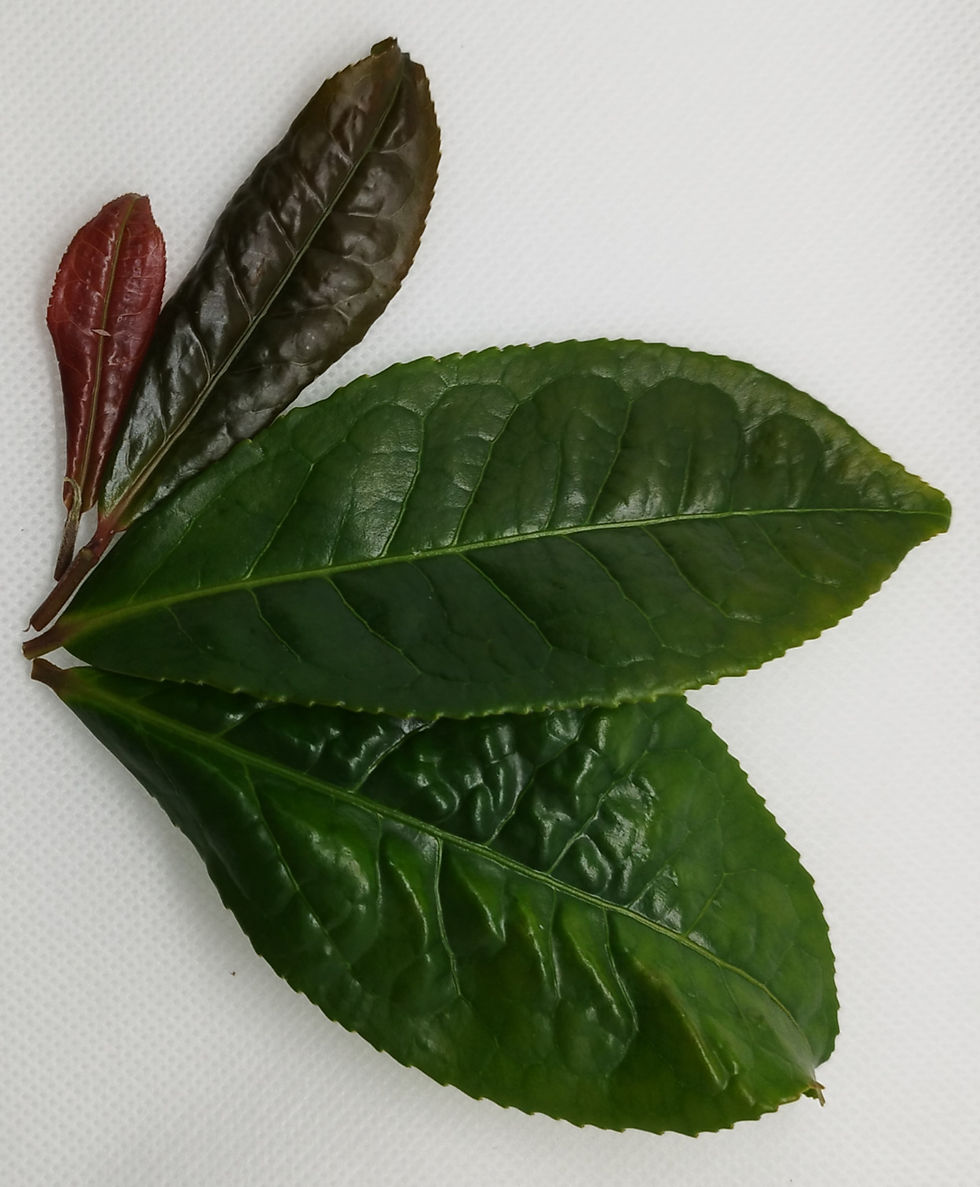
And the biggest determinants of the initial leaf caffeine content are genetics, the growing environment and the age of the leaf you pick.
The age of the leaf is important - generally the younger the leaf, the higher the caffeine. This is because younger leaves are more attractive to pesky insects and so ensuring a nasty trip becomes a priority. In practical terms, that means that bud teas are going to have slightly higher caffeine content than a traditional Oolong with 2, or even 3 leaves and a bud.
Some places are more prone to drought and seasonal temperature extremes. Some have thin soil and some have lots of organic matter. Some get lots of light and some are more shaded. Think of it a bit like Wine terroir. Some growers intentionally alter the growing environment to alter the chemical composition of the leaves. A classic example of this would be high-quality Japanese Matcha or Gyokuro, which are grown under shade cloth. This increases caffeine content, but also increases amino acid content and therefore, perceived smoothness of the tea.

Lastly, some Camellia varieties just have more of the stuff. There are hundreds of different tea Camellia varieties, which have been bred over thousands of years, so it’s probably not surprising that there is a lot of variability there.
So, you can’t necessarily tell without someone having tested it for you.
The are two other factors that can influence caffeine levels:
Ageing and
Leaf Size
Leaf size is probably the most important factor in caffeine infusion once you have your tea leaf. The smaller the leaf, the more quickly caffeine infuses. Teabags are actually designed to make use of this principle. In the business, we call them CTC tea, which, admittedly, sounds like a used car garage. It stands for cut-tear-curl, which is the process used to make it. The very fine particle size means that the tea infuses very rapidly into the cup, as does the caffeine.
Teabags also lead to a greater caffeine intake over time if you’re a tea drinker. This is because they are only designed for 1 infusion and so you may have many in a day. With leaf teas, you can infuse the same leaves many times, reducing the total caffeine load.
Of course, you have control over how you drink. If you have 4 cups from teabags then your total caffeine intake would be 120 - 160 mg, whereas if you infuse a leaf tea 4 times your total intake will be 30-40mg on average. Plus, the tea is likely to be a much better quality - I’ll be covering more on this in later videos.
Leaf ageing is common for Puer, White and Black teas. The longer the leaves are left to age, the lower the caffeine content will be. This is because there is some natural degradation of caffeine over time. So, in practice, a 15-year old white tea may have a lower caffeine content than a 5-year old white.
Lastly, does caffeine affect tea quality?
Well, like a lot of nasty compounds in foods, it's as bitter as a new divorcee. Caffeine is actually used in taste perception testing as one of the bitter compounds!
Teas with higher caffeine content might be prone to being more bitter, especially if brewed at higher temperatures. If a tea has higher caffeine then this needs to be counterbalanced by other factors (sweetness, umami, mouthfeel, etc) to produce a high-quality tea. If not, then it can become quite unpleasant.
Tips for managing your caffeine intake
If you want to control your caffeine intake a bit better then I have some helpful hints for you:
Start your day with the heavy stuff
Coffee
Matcha
Early season bud-only teas
Gradually progress to drinks that have less caffeine throughout the day
Midday - Black or Oolong
Afternoon - Aged White (Bigger leaf grade like Shou Mei)
Evening - Herbal Infusion or, from later this year, a Dragon’s Nectar speciality tea such as our 'Kings of the Underworld' Oolong.
Or, Just pick your tea and infuse multiple times over the afternoon.
If you want to know more about the science and art of teas and infusions I'll be continuing my series here on the blog and on Youtube! I'll see you there!

Comments